25 April 2020

DOWNLOAD BLACKMART ANDROID APP – DOWNLOAD PLAYSTORE PAID APPS FREE

Android made endless possibilities for everyone. It introduced a platform where are millions of apps that a user can download and buy depending on their needs. You're thinking about Google PlayStore, yes I am also talking about Google PlayStore. It's categorized app collection depending on every niche of life. Few of them are free and some of them are paid. Most of the paid apps are only charges small cost in between $2 to $8, but few apps are highly costly that make cost over $50 even, which is not possible for every user to buy and get benefit from it. So, here I am sharing a really useful app, that can make every Google PlayStore app for you to download it for free. You can download any paid app that may even cost about $50. It's totally free. Download blackmart Android app and download google play store paid apps freely.

DOWNLOAD BLACKMART ANDROID APP – DOWNLOAD PLAYSTORE PAID APPS FREE

  • It's extremely easy to use.
  • It has a Multilingual option for a global user experience.
  • The app doesn't ask for any payments.
  • Capable to download full of downloadable applications.
  • Super fast in downloading and installation.

Related word


Linux Command Line Hackery Series - Part 6


Welcome back to Linux Command Line Hackery series, I hope you've enjoyed this series so far and would have learned something (at least a bit). Today we're going to get into user management, that is we are going to learn commands that will help us add and remove users and groups. So bring it on...

Before we get into adding new users to our system lets first talk about a command that will be useful if you are a non-root user.

Command: sudo
Syntax: sudo [options] command
Description: sudo allows a permitted user to execute a command as a superuser or another user.

Since the commands to follow need root privileges, if you are not root then don't forget to prefix these commands with sudo command. And yes you'll need to enter the root password in order to execute any command with sudo as root.

Command: useradd
Syntax: useradd [options] username
Description: this command is used for creating new user but is kinda old school.
Lets try to add a new user to our box.
[Note: I'm performing these commands as root user, you'll need root privileges to add a new user to your box. If you aren't root then you can try these commands by prefixing the sudo command at the very beginning of these command like this sudo useradd joe. You'll be prompted for your root password, enter it and you're good to go]

useradd joe

To verify that this command has really added a user to our box we can look at three files that store a users data on a Linux box, which are:

/etc/passwd -> this file stores information about a user separated by colons in this manner, first is login name, then in past there used to be an encrypted password hash at the second place however since the password hashes were moved to shadow file now it has a cross (x) there, then there is user id, after it is the user's group id, following it is a comment field, then the next field contains users home directory, and at last is the login shell of the user.

/etc/group  -> this file stores information about groups, that is id of the group and to which group an user belongs.

/etc/shadow -> this file stores the encrypted password of users.

Using our command line techniques we learned so far lets check out these files and verify if our user has been created:

cat /etc/passwd /etc/group /etc/shadow | grep joe


In the above screenshot you can notice an ! in the /etc/shadow, this means the password of this user has not been set yet. That means we have to set the password of user joe manually, lets do just that.

Command: passwd
Syntax: passwd [options] [username]
Description: this command is used to change the password of user accounts.
Note that this command needs root privileges. So if you are not root then prefix this command with sudo.

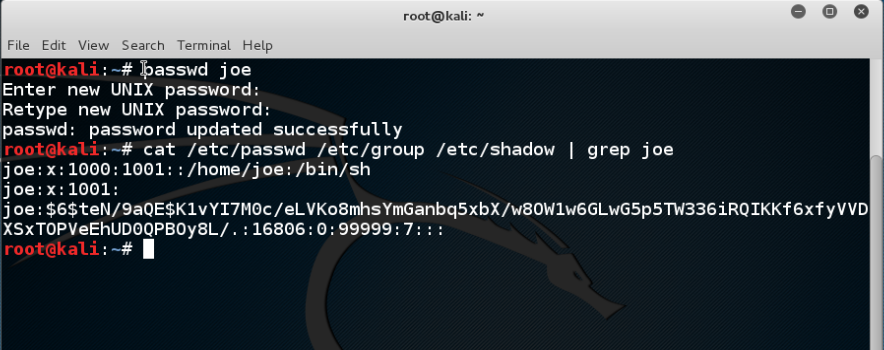
passwd joe


After typing this command, you'll be prompted password and then for verifying your password. The password won't show up on the terminal.
Now joe's account is up and running with a password.

The useradd command is a old school command, lets create a new user with a different command which is kinda interactive.

Command: adduser
Syntax: adduser [options] user
Description: adduser command adds a user to the system. It is more friendly front-end to the useradd command.

So lets create a new user with adduser.

adduser jane


as seen in the image it prompts for password, full name and many other things and thus is easy to use.

OK now we know how to create a user its time to create a group which is very easy.

Command: addgroup
Syntax: addgroup [options] groupname
Description: This command is used to create a new group or add an existing user to an existing group.

We create a new group like this

addgroup grownups


So now we have a group called grownups, you can verify it by looking at /etc/group file.
Since joe is not a grownup user yet but jane is we'll add jane to grownups group like this:

addgroup jane grownups


Now jane is the member of grownups.

Its time to learn how to remove a user from our system and how to remove a group from the system, lets get straight to that.

Command: deluser
Syntax: deluser [options] username
Description: remove a user from system.

Lets remove joe from our system

deluser joe

Yes its as easy as that. But remember by default deluser will remove the user without removing the home directory or any other files owned by the user. Removing the home directory can be achieved by using the --remove-home option.

deluser jane --remove-home

Also the --remove-all-files option removes all the files from the system owned by the user (better watch-out). And to create a backup of all the files before deleting use the --backup option.

We don't need grownups group so lets remove it.

Command: delgroup
Syntax: delgroup [options] groupname
Description: remove a group from the system.

To remove grownups group just type:

delgroup grownups


That's it for today hope you got something in your head.
More information

  1. Hacking Xbox One
  2. Hacking Tor Whatsapp
  3. Que Significa Hat
  4. Hacking Wifi Android
  5. Curso Growth Hacking
  6. Blog Hacking
  7. Hacking 2019
  8. Growth Hacking Tools

24 April 2020

Linux Command Line Hackery Series - Part 3


Welcome back, hope you are enjoying this series, I don't know about you but I'm enjoying it a lot. This is part 3 of the series and in this article we're going to learn some new commands. Let's get started

Command: w
Syntax:      w
Function:   This simple function is used to see who is currently logged in and what they are doing, that is, their processes.

Command:  whoami
Syntax:       whoami
Function: This is another simple command which is used to print  the  user  name  associated  with the current effective user ID.

Try it and it will show up your user name.

If you want to know information about a particular user no matter whether it is you or someone else there is a command for doing that as well.

Command: finger
Syntax:      finger [option] [username]
Function:   finger is a user information lookup program. The [] around the arguments means that these arguments are optional this convention is used everywhere in this whole series.

In order to find information about your current user you can simply type:

finger username

Here username is your current username.
To find information about root you can type:

finger root

and it will display info about root user.

Command: uname
Syntax:      uname [options]
Function:   uname is used to display information about the system.

uname is mostly used with the flag -a, which means display all information like this:

uname -a

Command: df
Syntax:      df [option] [FILE ...] 
Function:   df is used to display the amount of space available.
If you type df in your terminal and then hit enter you'll see the used and available space of every drive currently mounted on the system. However the information is displayed in block-size, which is not so much human friendly. But don't worry we can have a human friendly output as well using df by typing:

df -h

the -h flag is used to display the used and available space in a more user friendly format.
We can also view the info of a single drive by specifying the drive name after df like this:

df -h /dev/sda2

That's it for now about df, let's move on.

Command:  free
Syntax:       free [options]
Function:    free is used to display the amount of free and used physical memory and swap memory in the system.
Again the displayed information is in block-size to get a more human readable format use the -h flag like this:

free -h

Command: cal
Syntax:      cal [options]
Function:    cal stands for calendar. It is used to display the calendar.

If you want to display current date on the calendar you can simply type:

cal

and wohooo! you get a nice looking calendar on screen with current date marked but what if you want to display calendar of a previous month well you can do that as well. Say you want to display calendar of Jan 2010, then you'll have to type:

cal -d 2010-01

Nice little handy tool, isn't it?

Command: file
Syntax:      file filename ...
Function:   file is an awesome tool, it's used to classify a file. It is used to determine the file type.

Let's demonstrate the usage of this command by solving a Noob's CTF challenge using file and base64 commands. We'll talk about base64 command in a bit. Go to InfoSecInstitute CTF Website. What you need to do here is to save the broken image file on your local computer in your home directory. After saving the file open your terminal (if it isn't already). Move to your home directory and then check what type of file it is using the file command:

cd
file image.jpg

Shocking output? The file command has identified the above file as an ASCII text file which means the above file is not an image file rather it is a text file now it's time to see it's contents so we'll type:

cat image.jpg

What is that? It's some kind of gibberish. Well it's base64 encoded text. We need to decode it. Let's learn how to do that.

Command: base64
Syntax:       base64 [option] FILE ...
Function:    base64 command is used to encode/decode data and then print it to stdout.

If we're to encode some text in base64 format we'd simply type base64 hit enter and then start typing the text in the terminal after you're done hit enter again and then press CTRL+D like this:

base64
some text here
<CTRL+D>
c29tZSB0ZXh0IGhlcmUK        # output - the encoded string

But in the above CTF we've got base64 encoded data we need to decode it, how are we going to do that? It's simple:

base64 -d image.jpg

There you go you've captured the flag.
The -d flag here specifies that we want to decode instead of encode and after it is the name of file we want to decode.

Voila!
So now you're officially a Hacker! Sorry no certificates available here :)

That's it for this article meet ya soon in the upcoming article.
More info

23 April 2020

Secret Hack Codes For Android Mobile Phones

Secrete Hack codes for Android Mobile phones

Secret hack codes are usually hidden from users to prevent misuse and exploit. Android is a very new platform so there aren't many hack codes for Androids available. Today I will share all of the hack codes of Android cellphones that I know. I have tested these codes on my Samsung Galaxy with the Android OS version 2.2. I am sure these will work on all previous versions. 


Secret Hack Codes for Android Mobile Phones:


1. Complete Information About Your Phone 

 *#*#4636#*#*

 This code can be used to get some interesting information about your phone and battery. It shows the following 4 menus on the screen:

  • Phone information
  • Battery information (How to maximize or boost battery life in android phones)
  • Battery history
  • Usage statistics


2. Factory data reset


*#*#7780#*#*

This code can be used for a factory data reset. It'll remove the following things:

  • Google account settings stored in your phone
  • System and application data and settings
  • Downloaded applications

It will NOT remove:

  • Current system software and bundled application
  • SD card files e.g. photos, music files, etc.

Note: Once you give this code, you will get a prompt screen asking you to click on the "Reset phone" button, giving you the chance to cancel your operation.


3. Format Android Phone


  *2767*3855#

Think before you input this code. This code is used for factory formatting. It will remove all files and settings, including the internal memory storage. It will also reinstall the phone firmware.

Note: Once you give this code, there is no way to cancel the operation unless you remove the battery from the phone.


4. Phone Camera Update


*#*#34971539#*#*

This code is used to get information about phone camera. It shows following 4 menus:

  • Update camera firmware in image (Don't try this option)
  • Update camera firmware in SD card
  • Get camera firmware version
  • Get firmware update count

WARNING: NEVER use the first option. Your phone camera will stop working and you will need to take your phone to a service center to reinstall camera firmware.


5. End Call/Power


*#*#7594#*#*

This one is my favorite. This code can be used to change the action of the "End Call/Power" button. Be default, if you hold the button down for a long time, it shows a screen asking you to select between silent mode, airplane mode, and power off.

Using this code, you can enable this button to power off without having to select an option, saving you some time.


6. File Copy for Creating Backup


*#*#273283*255*663282*#*#*


This code opens a file copy screen where you can backup your media files e.g. images, sound, video and voice memo.


7.  Service Mode


*#*#197328640#*#*

This code can be used to enter into service mode. In service mode, you can run various tests and change settings.


8. WLAN, GPS and Bluetooth Secret Hack Codes for Android:


*#*#232339#*#* OR *#*#526#*#* OR *#*#528#*#*           – WLAN test (Use "Menu" button to start various tests)

*#*#232338#*#*                  – Shows WiFi MAC address

*#*#1472365#*#*                – GPS test

*#*#1575#*#*                      – Another GPS test

*#*#232331#*#*                  – Bluetooth test

*#*#232337#*#                    – Shows Bluetooth device address


9. Codes to get Firmware version information:


*#*#4986*2650468#*#* – PDA, Phone, H/W, RFCallDate

*#*#1234#*#* – PDA and Phone

*#*#1111#*#* – FTA SW Version

*#*#2222#*#* – FTA HW Version

*#*#44336#*#* – PDA, Phone, CSC, Build Time, Changelist number


10. Codes to launch various Factory Tests:


*#*#0283#*#* – Packet Loopback

*#*#0*#*#* – LCD test

*#*#0673#*#* OR *#*#0289#*#* – Melody test

*#*#0842#*#* – Device test (Vibration test and BackLight test)

*#*#2663#*#* – Touch screen version

*#*#2664#*#* – Touch screen test

*#*#0588#*#* – Proximity sensor test

*#*#3264#*#* – RAM version


@EVERYTHING NT

Read more

Diggy - Extract Enpoints From APK Files


Diggy can extract endpoints/URLs from apk files. It saves the result into a txt file for further processing.


Dependencies
  • apktool

Usage
./diggy.sh /path/to/apk/file.apk
You can also install it for easier access by running install.sh
After that, you will be able to run Diggy as follows:
diggy /path/to/apk/file.apk


Related posts